Free Complete Toolkit for Boards

© Copyright Carter McNamara, MBA, PhD, Authenticity Consulting, LLC -- experts in nonprofit Boards!.
Applies to for-profit and nonprofit Boards, unless marked differently.

NOTICE! Many new articles about Boards!
To see the list of new articles, click
here


Board Operations (Below):

Introduction and Overview

Board Roles and Responsibilities

Overview: Operations and Systems

Articles, Bylaws, Resolutions, Policies

Legal, Lobbying, Ethics and Risk

Staffing the Board

Compensating Board Members

Board Orientation/Training

Committees, Task Forces, Advisory Groups

Ensuring Successful Meetings

Board and Staff Relations

Evaluating the Board and Members

Here are a variety of free Board self-evaluation tools. Aim to select a tool that asks at least as much about the actual occurrence of activities on your Board as about how members feel about the Board. It's good practice to have a small team of Board members review and select the best tool. It's often best if each Board member completes a tool on his/her own, rather than together in a group. Also, the best time to do a Board evaluation is now. Don't wait until new members have learned more about the Board -- that's like waiting until you feel fine before seeing the doctor. Keep in mind that Board members of nonprofits are volunteers and their time is often very limited, so pick a tool that Board members will even have enough time to complete.

Advanced Topics

General Resources

Board Governance (Below):

Starting an Organization

Supervising the CEO

Overall Planning

Human Resource Management

Finances and Taxes

Fundraising

Marketing and Public Relations

Organizational Evaluation and Development


Introduction and Basic Overview

What is a Board of Directors? What Does a Board Look Like?

A corporation, whether for-profit or nonprofit, is required to have a governing Board of Directors. To explain, a corporation can operate as a separate legal entity, much like a person in that it can own bank accounts, enter into contracts, etc. However, the laws governing corporations require that a corporation ultimately is accountable to its owners (stockholders in the case of for-profits and the public with nonprofits). That accountability is accomplished by requiring that each corporation has a Board of Directors that represents the stockholders or the public.

Members of a governing Board have certain legally required (fiduciary) duties, including duties of care, loyalty and obedience (some states and countries use different terms -- for example, in Canada, the duties of care and loyalty are often stressed). For-profit Boards often are referred to as "corporate" Boards, which really is a misnomer because both nonprofit and for-profit corporations are required to have Boards -- not just for-profit corporations.

The phrase "Board operations" often refers to the activities conducted between Board members and can include development and enactment of Board bylaws and other Board policies, recruitment of Board members, training and orientation of Board members, organizing Board committees, conducting Board meetings, conducting Board evaluations, etc. The phrase "governance" often refers to the Board's activities to oversee the purpose, plans and policies of the overall organization, such as establishing those overall plans and policies, supervision of the CEO, ensuring sufficient resources for the organization, ensuring compliance to rules and regulations, representing the organization to external stakeholders, etc. The nature of Board operations and governance depends on a variety of factors, including explicit or implicit use of any particular Board model, the desired degree of formality among Board members and the life-stage of the Board and organization.

Governing Boards can have a variety of models (configurations and ways of working), for example, "working Boards" (hands-on, or administrative, where Board members might be fixing the fax one day and strategic planning the next), "collective" (where Board members and others in the organization usually do the same types of work -- it's often difficult to discern who the Board members actually are), "policy" (where Board members attend mostly to top-level policies), "Policy Governance" (trademark of Carver Governance Design, where there are very clear lines and areas of focus between Board and the CEO), etc. All of these models are types of governing Boards.

Boards can have a broad range of "personalities." For example, Boards of large for-profit and nonprofit corporations might be very formal in nature with strong attention to Parliamentary procedures, highly proceduralized Board operations, etc. In contrast, Boards of small nonprofit or for-profit corporations might be very informal in nature. Some people believe in life stages of Boards, including that they 1) start out as "working" Boards where members focus on day-to-day matters in addition to strategic matters, 2) evolve to "policy" Boards where members focus mostly on strategic matters, and 3) eventually become large, institutionalized Boards that often have small executive committees and maybe many members some of which are "big names" to gain credibility with funders or investors.

For-Profit ("Corporate") Boards Compared to Nonprofit Boards

People might be surprised to read that there are more similarities between for-profit and nonprofit Boards than there are differences -- after all, both types of organizations are required to have Boards because both types are corporations, thereby having similar fiduciary responsibilities among members. Members of both types of Boards must attend to the many activities involved in Board operations and governance. Both types of organizations must conform to rules and regulations for operations of corporations within their states/provinces and countries, including for employment laws and tax filings (each type of organization files different types of federal tax forms). Thus, many of the topics included throughout this overall Library topic on Boards are relevant to both types of organizations.

Certainly, there are differences. For-profit Board members often are paid, whereas nonprofit Board members usually are not (except to be reimbursed for expenses). For-profit Board members uniquely attend to decisions about dispersing profits to owners (to stockholders), for example, in the form of stock equity and dividends, whereas nonprofit Board members do not seek to maximize and disperse profits to the owners -- the owners of nonprofits are members of the public. Nonprofit Board members often must participate in robust fundraising by soliciting funds from individuals, foundations, corporations and government entities. Nonprofits corporations often enjoy certain tax advantages, including tax-exemption (being able to avoid payment of certain taxes) and charitability (so donors can deduct donations from their taxes). To retain that charitable tax status, Board and staff members of nonprofits must refrain from exceeding certain limits of lobbying and self-dealing.

The following link depicts a concise comparison of for-profit to nonprofit corporations:
How Nonprofits Compare to For-Profits

Be sure to see the many general resources for Boards in the USA and Canada, near the end of this Web page. Also see the closely "Related Library Topics" and "Recommended Books" referenced from the bottom of the page.


Overview of Board Roles and Responsibilities

Roles and Responsibilities

The above section gives a basic overview of the role of a governing Board. The following links give more information about the roles and responsibilities of Boards and Board members, including job descriptions for each of the common positions on a Board.

For-Profit

Board Roles and Responsibilities (for-profit and nonprofit)
"System" of Board Operations (one-page depiction of for-profit)

Nonprofit

Governance and Board Development (nonprofit)
Fiduciary Responsibilities of Nonprofit Board Members
How Much Should Nonprofit Board Be Involved in Management?
Outline of Board Roles and Responsibilities (nonprofit)
History of Nonprofit Boards in the U.S. (nonprofit)
Eight Basic Expectations a Chief Executive Has of His or Her Board
Good Governance in Meeting the Duties of Directors of Charities and Not-for-Profits
What Exactly IS the Board's Job?

Job Descriptions

Sample Job Descriptions
Board and Staff Roles
Job Description Search Tool


Overview: Board Operations and Systems

Recurring, Annual Operations

Boards meet their responsibilities usually by conducting certain major activities at certain times of the year. Often, the bylaws specify when certain activities will be conducted. Activities include, for example, conducting regular Board meetings (every month, two months, etc.), conducting the Board self-evaluation, evaluating the chief executive, reviewing and updating Board and personnel policies, conducting strategic planning, recruiting new members, holding an annual meeting, reviewing and authorizing the yearly budget, conducting fundraising (in the case of nonprofits), etc. The following sample Board Operations Calendar lists typical recurring activities of the Board and suggests the timing for these activities.
Sample Board Operations Calendar

Overall "System" of Board Operations

Below, in the links about systems, are handy one-page depictions of the various inputs to the operations of a Board, the Board processes that influence those inputs, and the various outputs from Board operations. This information gives a concise "snapshot" of the recurring activities -- the loop of activities -- in a Board. The links about where Boards "fit" are to one-page depictions that indicate the role of the Board in the overall planning, development, operations and evaluations in the organization.

For-Profit Boards

Depiction of the system of a for-profit Board
Depiction of where Board activities "fit" in for-profit organizations

Nonprofit Boards

Depiction of the system of a nonprofit Board
Depiction of where Board activities "fit" in nonprofit organizations


Articles, Bylaws, Resolutions, Policies

Articles of Incorporation

The articles of incorporation (or other forms of description, such as charters, constitutions, articles of association, etc.) are established when the organization files for incorporation with the appropriate state or provincial agency. A Board of Directors gets its authority from the articles. This governing document specifies, for example, its name, the purpose or mission of the organization, place of business, primary officers, etc.

In Canada, you can form a nonprofit corporation either at the provincial or federal levels, and you might be able to form under a variety of regulations, for example, a provincial Societies Act or Companies Act, or the federal Canada Corporations Act. In Canada, it is necessary to be incorporated in order to become a charity.

For-profit Organization

Sample articles of incorporation form (the form depends on each state)
Sample Articles of Incorporation
Sample Articles of Incorporation for a Company Corporation

Nonprofit Organization

Sample Articles of Incorporation
Another sample articles of incorporation form
Sample Articles of Incorporation

Corporate Bylaws (Board's internal specification of how the Board will be organized and operated)

Bylaws specify the Board's rules of internal operation, for example, number of members of the Board, length of the terms of membership, all of the officer positions, how meetings are conducted, etc. In some states in the USA and provinces in Canada, you have to have Bylaws to file for incorporation.

For-profit Organization

What are bylaws and why are they important?"
Sample bylaws
Another sample
Another sample

Nonprofit Organization

Ample nonprofit bylaws
Another sample bylaws
Another sample
Amending or Changing the Bylaws

Board Resolutions (single acts of approval for, eg, contracts, dues, etc.)

Articles, charters, constitutions, etc., and bylaws are ongoing rules. A resolution is used by the Board to draw attention to a single act or Board decision, for example, to approve or adopt a change to a set of rules, new program, new contract, etc. Resolutions are included in the minutes for the Board meeting. Here is a sample.
Sample Board Resolution

Board Policies (Board's guidelines for how members will work together)

Board policies are guidelines for how the Board members can best work together, e.g., when they want to meet, how members should be on Committees, how they recruit and orient new members, how they manage for consistent meeting attendance, how the Board will work with the chief executive officer, how they will avoid conflict-of-interest, etc.

Board Policy Manuals and Miscellaneous

Typical Contents of Nonprofit Board Member's Manual
Maintaining Board and Organizational Confidentiality
Sample Board Policies
Sample Document Retention/Destruction Policy
Sample Whistleblower Policy
Another Board policy manual

Board Attendance

Sample Board Attendance Policy
Another sample
Sample Board Attendance Policy

Conflict of Interest

NOTE: Many experts believe that the conflict-of-interest terms should be in the bylaws, rather than Board policies. Often, state statute (which takes precedence over bylaws) specifies terms to avoid conflict of interest.

What is a "conflict of interest?"
What goes in a conflict-of-interest policy
My Board member says to use her/her relative as a vendor?
How Do We Safeguard Against Conflict of Interest?
Conflict of Interest


Accountability, Legal, Lobbying, Ethics and Risk

There is more emphasis on Board accountability than ever before, especially because of growing public concern in the U.S. about large salaries paid to CEOs of large, publicly traded for-profits; numerous occasions of corruption in those types of organizations; and the "Enron" debacle where the public perceived that the Enron Board did not exercise due diligence in governing that corporation. At its most basic, accountability is having to report to a certain constituency (for example, to stockholders in the case of for-profits and to the public in the case of nonprofits) about what an organization is going to accomplish and also the status of achieving those accomplishments. Accountability is being responsible and accepting the consequences of the actions of the organization, whether those consequences are positive or negative. Progressive and socially responsible organizations take that definition of accountability even further and see themselves as being responsible to "stakeholders" -- to groups of citizens who have a direct or indirect interest in the operations and effects of the organization.

Accountability

Better Accountability: A Different Approach for Reporting to the Membership
Governing for What Matters: A Model for Community-Driven Governance
Nonprofit Governance and Accountability
Learning from Sarbanes-Oxley: Checklist for Accountability

Legal Considerations

Nonprofit

What are the Board Member's Legal Responsibilities?
Sarbanes-Oxely Act (USA legislation) and Implications for Nonprofits

Broadbent Report (Canadian Report)

For-Profit

Sarbanes-Oxely Act (for for-profits and nonprofits)
Overview of legal considerations
Overview of Liability Insurance (including Directors' and Officers' Insurance)
What do do until the lawyer comes ...

Lobbying (Nonprofit)

Lobbying and Taxes
Yes or No, Lobbying by Nonprofits

Ethical Considerations

Resources for Writing a Code of Ethics
Five Questions that Corporate Boards of Directors Should Ask (for-profit)
Guide to Managing Ethics in the Workplace
Ethical Guidelines for Board Members of Not-for-Profit Organizations

Insurance and Risk Management

How to Minimize Liabilities of Nonprofit Board Members
A Primer on D&O Insurance
Why Purchase D&O Insurance?

Insurance Considerations for Board Members
Risk Management Resources
Risk Management Topic in Free Management Library
Crisis Management Topic in Free Management Library


Staffing (Size, Joining, Recruiting, Informing, Communicating, Rewarding, Removing)

One of the most important aspects of Board operations is Board staffing. Just like the careful staffing that is usually done with employees, Board members should be carefully selected, trained and evaluated, as well. In for-profits, Board members and leaders must appreciate the strong value that Boards can bring, rather than tolerating Boards as if they are some necessary evil to be avoided at all costs. In nonprofits, Board members and leaders should not approach recruitment and selection as if they are somehow lucky just to get Board members who will show up at Board meetings. Board members and leaders in those organizations must act as if they deserve a very dedicated and participative Board -- that attitude alone can make a huge difference in achieving highly effective Boards.

There are different perspectives on staffing. Some people believe that Boards should be staffed primarily with the expertise needed to establish and achieve current strategic goals (this is functional staffing). Others believe that staffing should also achieve a wide diversity of values and perspectives among members on the Board (diversification staffing). In nonprofits, members are also sought who have strong passion for the mission (passion-driven staffing). We're learning, though, that passion alone is not enough -- Board members also must have the time and energy to actively participate in the Board. Yet another pespective is to get members who represent the major constituents of the organization (representative staffing).

Ironically, many people perceive for-profit Boards as being more established and effective. Yet nonprofit Boards very often have highly involved members who take a very strong role in establishing strategic plans and in ensuring that those plans are achieved. Board members of for-profit and nonprofit organizations have much to learn from each other.

Board Size

The Determinants of Corporate Board Size and Composition: An Empirical Analysis (for-profit)
Board size and corporate performance: evidence from European countries
Choosing a Board of Directors (for-profit, includes info about size)

What is the Average Size for a Board?
What is the Best Size for Your Board?
How Big Should a Board Be and How Often Should They Meet?

Term Limits

Coming to Terms With Term Limits
Term Limits (Rotation) for Board Members
Should Board of Directors Have Term Limits?

Composition of Board Members

Approaches/Philosophies to Staffing Nonprofit Boards
How Should a Board Determine Competencies Needed on the Board?
Sample Board Recruitment Grid (nonprofit)
How can we promote diversity while avoiding tokenism?

Joining a Board (potential new member's perspective)

Questions to Ask Yourself Before Joining Your Next Board
Sample Board Application Form
What You Need to Know About Our Board

Recruiting Board Members

Recruiting for Board Members
Prospective Board Members Who Are Not Ready!
4 Cool Ideas for Recruiting Board Members
Avoiding Pitfalls in Recruiting Board Members
Guidelines for Recruiting New Members
Sample Board Recruitment Grid
Sample Board Application Form
Guidelines for Orienting New Members
Recruiting Board Members, Volunteers and Participation
The Diversity Issue - Part 1 (scroll down)
The Diversity Issue - Part 2 (scroll down)
Board Diversity: Bigger Issue Than You Think
10 Stop Signs on the Road to Board Recruitment
Recruiting Your Organization's First Board
Recruiting for Board Members: Process? What Process?
Board Recruitment: Whose job is it anyway?
Nonprofit Board of Directors Guidelines

Informing, Communicating With Board Members

How Do We Keep Members Informed?
Wikipedia on Board Manuals
Sample Board Manual Index
Annual Reports
The Board Manual
Addressing Board Knowledge Gaps

Rewarding / Recognizing Board Members

The following link is useful for nonprofit Boards. For-profit Board members often are compensated monetarily (see the next section).

Rewarding Volunteers (includes several other links)

Removing Board Members

Removing a Board Member (scroll down)
How Boards Deal with Lazy Directors
How to Remove a Board Member
How do we remove a Board member
How do we remove a Board member?
The Diversity Issue - Part 2 (scroll down)


Compensating Board Members

Members of for-profit Boards often are compensated monetarily, usually as a flat fee plus reimbursement for expenses. Often, the larger the organization and its revenues, the larger the compensation to the Board members. Members of nonprofit Boards usually are not compensated with a flat fee. They can be compensated as reimbursement for expenses.

In For-Profit (Corporate) Boards

Compensation for Board Members
Governance, the Board and Compensation

In Nonprofit Boards

Are Nonprofit Boards Asleep at the Wheel? (asserts members should not be paid)
May a Member of a Nonprofit Board Be Paid?
How Much Do I Get Paid to Be On This Nonprofit Board?


Orienting and Training Board Members

Orientation and Agenda

Board training conveys the knowledge and understanding needed in order to be effective as a member of any governing Board of Directors, for example, legal responsibilities. Board orientation is training about the organization-specific information in order to be effective particularly as a member of the organization's Board of Directors, for example, about where the Board meets, who's on the Board now, etc. Selection of training topics and training methods depend on the nature and needs of the organization. However, the following guidelines and sample training agenda might serve useful to the reader when designing their own training plan and methods.

Basic Guidelines and Sample Agenda for Board Training Session
Orientation and Training of Board Members
Why Board Orientation? (complete manual)

Ongoing Education

Ongoing Board Education: Ensuring Board Members Have the Knowledge They Need
Team Building (many resources listed there)


Board Committees, Task Forces, Advisory Groups and Work Plans

It's common for Board members to be organized into Committees. Some Board models, including the Policy Governance Model (a registered trademark of John Carver), minimize or avoid committees altogether. Some Committees are increasingly popular, including the Audit Committee and Compensation Committee in for-profits and the Board Development (or Board Governance) Committee in nonprofits.

Advisory Boards (or Advisory Committees or Advisory Groups) are increasingly common. They can be used as formalized means to get highly focused advice and recommendations about certain topics or even to attend to specific activities, such as researching an issue or overseeing the construction of a facility. Sometimes these groups are formed merely to "park" people who have served admirably on the governing Board or to associate "big names" with the organization. Frequently, these types of unfocused groups result in confusion and frustration for its members. For the organization to get the most value -- and for the members of the group to get the most satisfaction -- the advisory group should be almost as carefully planned, organized and monitored as the governing Board itself.

One way to organize, focus and activate Committees is by associating a work plan with each. A work plan usually includes specific goals, objectives and deadlines for achievement. Often those goals are aligned with goals in an overall strategic plan. In Board meetings, each Committee reports status on implementing its work plan.

This author realized years ago that the best way to keep good Board members is to make sure they have something to do -- and the best way to get rid of bad Board members is to make sure they have something to do. Implementation of work plans gives Board members something to do.

Board Committees and Work Plans

Description of Typical Committees
Advantages and Disadvantages of Nonprofit Board Committees
Should Boards Have Committees and, If So, Which Ones?
Executive Committees
The Governance Committee
Setting Up an Audit Committee
Governance Committee Sample Terms of Reference
Committee Essentials
Sample Committee Work Plan

Activating Committees and Board

Ideas to Generate Participation
The Most of Our Time Together
Effective Committees
Purpose of Committees
How to Ensure Board is Involved in Projects for Change (for-profit)
How to Ensure Board is Involved in Projects for Change (nonprofit)
Motivating Your Board

Advisory Groups

Advisory Groups
How to Form a Nonprofit Advisory Board
Harness the Power of An Advisory Board
Advisory Board Meeting Agenda


Board Meetings, Meeting Process, Retreats, etc.

Members of the Board do their work, primarily in their Board meetings. Thus, these meetings should be carefully planned, facilitated and documented. Meetings can be highly participative with very focused deliberations that result in strong, strategic decisions -- decisions that are captured in meeting minutes and then closely monitored for implementation. Or, meetings can drag on with only some members participating -- participating in spotted discussions about whatever topic was first brought up in the meeting. It's often the most dedicated Board members who become frustrated with these unproductive Board meetings and soon leave the organization, leaving the rest of the members to continue this ineffective approach to Board governance.

One of the most effective ways to accomplish productive meetings -- and strong governance -- is to carefully design an agenda and then closely facilitate to that agenda. Agendas should include 1) strategic topics to address in that meeting, 2) specification of how each topic is to be addressed in that meeting (for example, to make a decision, assign further research, etc.), and 3) specific times to address each topic. Without that careful design and facilitation of the agenda, Board meetings too often result in prolonged confusion and frustration of members -- and overall ineffective governance of the organization.

Board Meeting Agenda and Minutes (and Decisions During Meetings)

Meeting Management (many resources listed there)
Sample Meeting Agenda
Strategic Questions That Nonprofit Board Members Should Always Ask in Meetings
Sample Meeting Minutes
Should Movers and Seconders Be Recorded in Minutes?
Importance of Board Minutes
Managing Board Process and Information
What is the Procedure for Handling Confidential Matters?
What is a Consent Agenda?
Consent Agenda
Helping the Decision-Impaired Board
Staff at Board Meetings

Parliamentary Procedure for Meetings

Jim Slaughter's many resources
Roberts Rules (the official site)
Rules Online
Trout's Top Ten Rules of Order

Board Retreats

How Do I Use Retreats in the Planning Process? (scroll down)
Where to Have a Board Retreat

Maximizing Board Attendance

Sample Board Attendance Policy
The Most of Our Time Together

Online Meetings

State Laws for NPO Board Meetings by Teleconference
Facilitating Online Meetings
Virtual Teams
Using Technology to Improve Board Performance
Board Policy for E-mail Motion, Discussion and Voting Procedures

Executive (In-Camera) Meeting

Should the Board Hold Executive Sessions?


Board and Staff Relations

The nature and extent of interactions between Board members and staff (employees) depends on the Board model used by the organization. Often, the model is not intentionally and explicitly chosen -- it's the result of how members ended up working together. Working (or hands-on) Boards often include members interacting with employees on a regular basis. In contrast, in policy Boards, Board members and employees often do not have strong interaction with each other; however, employees might attend Board meetings to give reports or participate in certain Board Committees. In any case, it's often wise for Boards and executives to specify the nature and extent of interaction expected between Board members and employees.

In addition, there are certain practices that ensure that Board members and employees have strong appreciation of each other's roles and can contribute to each other's accomplishments. Links in this section help Board members and employees to maximize their mutual understanding and contributions in the workplace.

Board and Staff Roles

Board and staff roles
How Much Should Nonprofit Board Be Involved in Management?

Board and CEO Role and Relations

How the Nonprofit Board and CEO Are in Strategic Relationship
What should be the relationship between the Chief Executive Officer and the Board (nonprofit)
Sustaining High-Quality Relationship Between Chair and Chief Executive
Should the executive director be a member of the Board? (nonprofit)
Board Members Seeking Staff Position
Staff at Board Meetings

Board and Staff Relations

Should Staff Contact with Board Be Restricted?
Numerous questions about Board and staff relationship (nonprofit)
Board Staff relations
Board versus management conflicts
Building Trust Between Boards and Staff


Evaluating the Board and Members

One of the most powerful practices for Board members is to evaluate the quality of their Board operations. Many times, Board members do not know what they do not know about their own Board. For example, they might be terribly ineffective because they all have fallen into a rut in their operations -- and they have not even realized it. Or, they might have gotten side-tracked into attending to certain urgent matters (for example, the latest crisis reported by the Chief Executive Officer), and are ignoring very important matters (for example, strategic planning that would have avoided those crises altogether).

Board members who claim that they do not need evaluation and Board training are like obese people who claim that they do not need advice about eating because, after all, they are already experts at eating. Experienced and highly effective Board members have learned that it's critical to regularly conduct short, practical evaluations of the quality of their Board operations and then to attend to the results of those evaluations during the year. Evaluations need not take a long time -- many times, even 15 minutes a year from each Board member to complete a short questionnaire, followed by half an hour to discuss results, can be transformational for a Board.

Reasons to Do, How to Do

How to Evaluate Executive Director (nonprofit)
Hiring, Evaluating and Working With Your Executive Director (nonprofit)
Evaluating the Board of Directors

Sample Procedures

Board Self-Evaluation
Checklist to Evaluate Health of Board
Nathan Garber's checklist
Quick Assessment of the Five Dysfunctions of Your Board

Individual Board Member Evaluation

Individual Board Member Evaluation
Board Member Self-Evaluation


Advanced Topics

Board Models

As mentioned above, Board members often adopt a model or way of working together. Many times, the model is not intentionally or explicitly selected by Board members. They just ended up working together in the same way. There are several types of Board models and others are emerging; however, the research is not conclusive about which models are best to use and when. Perhaps the most valuable result for Board members from reading about models is first learning the many ways that members can work together and then by reflecting on their own Board operations.

Some New Nonprofit Board Models
Types of Board Committees
Board Structure
Comparison of Board Models
Carver Governance Model (Policy Governance) (more on this topic below)
Governance Models
Governing for What Matters: A Model for Community-Driven Governance

Board Development

It might help the reader to understand the concept of Board development by comparing it to Board orientation and Board training. Here's one interpretation. Board orientation is orienting Board members about the unique aspects of the organization, for example, its history, products and services, other Board members, etc. Board training is training members about the standard roles and responsibilities of members of any governing Board. In contrast, Board development is raising the quality of Board operations up another level, including by using a Board pre-assessment, Board orientation, Board training, coaching of Board members, and closing with a Board post-assessment to measure any improvement from the Board development. The following links provide a range of advice about improving the quality of Board operations.

Some Types of Broken Nonprofit Boards
Why Board Training and Team Building Alone Seldom Fix Broken Boards
General Principles for Restoring Nonprofit Boards
The Cost of Governance
Founder's Syndrome: Who? Me?
Founder's Syndrome: How Organizations Suffer -- and Can Recover (a manual)
Make Your Board Room an Oasis
Why Boards Micromanage and How to Get Them to Stop
Board's Evolving Role: From Management to Governance
Has Your Organization Outgrown Its Board?
Dysfunctional Board or Council?
Enhancing The Board's Monitoring Role
Good Governance and Crisis
Good Governance
Moving to Good Governance: Digging Into Organizational Change
Policy-based Governance: If It's So Great, Why Isn't Everyone Using It?

The Top Reasons to Use Policy Governance (copyright of John Carver)
Policy Governance in 2002
A Checklist for Determining the Extent Policy Governance® is Being Used by a Board
Desirable Board Member Attributes Under Policy Governance®


Additional Online Resources

General Resources Focused on Boards of Nonprofits

Boardsource's extensive FAQ about Boards
National Study of Good Governance Practices in the Nonprofit and Voluntary Sector in Canada
Board Glossary
Nonprofit FAQ on Boards
Jane Kendall's "What it takes to be a good Board member"
National Alliance for Nonprofit Organizations
Minnesota Council of Nonprofits "Principles and Practices"
Help4Nonprofits
Nonprofit Good Resource Guide
Nathan Garber
Great Grassroots Governance for Nonprofits and Funders
Nonprofit Board Basics Online

General Resources Focused on Boards of For-Profits

Corporate Survival Guide
Corporate Governance Codes & Principles
Founder's Syndrome -- How Corporations Suffer -- and Can Recover
Corporate Governance At The Speed Of Light
Corporate Governance
Corporate Library
Global Corporate Governance Forum
International Corporate Governance Network
Corporate Governance Magazine


Submit a link


For the Category of Boards of Directors:

Related Library Topics

Recommended Books

For-Profit ("Corporate") Boards of Directors

Nonprofit Boards of Directors


For-Profit ("Corporate") Boards of Directors

The following books are recommended because of their highly practical nature and often because they include a wide range of information about this Library topic. To get more information about each book, just hover your cursor over the image of the book. A "bubble" of information will be displayed. You can click on the title of the book in that bubble to get more information, too.


Nonprofit Boards of Directors

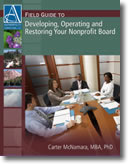
Book Cover Field Guide to Developing, Operating and Restoring Your Nonprofit Board
by Carter McNamara, published by Authenticity Consulting, LLC. Provides step-by-step, highly practical guidelines to organize, operate and sustain high-quality nonprofit Boards -- and to fix a broken Board! Includes variety of Board models you can choose from, roles and responsibilities, how to get the best members, how to train and organize them, goals for standard committees, ensuring high-quality meetings, evaluating Boards, how to evaluate and/or replace the Executive Director, and much more! Includes many sample Board policies you can download! Written by the developer of the Free Management Library. Many materials in this Library's topic about Boards are adapted from this book. 30-day, money-back, guarantee!
Book Cover Field Guide to Leadership and Supervision With Nonprofit Staff
by Carter McNamara, published by Authenticity Consulting, LLC. Provides step-by-step, highly practical guidelines to recruit, utilize and evaluate the best staff members for your nonprofit. Includes guidelines to effectively lead yourself (as Board member or staff member), other individuals, groups and organizations. Includes guidelines to avoid burnout -- a very common problem among nonprofit staff. Written by the developer of the Free Management Library. Many materials in this Library's topic about leadership and staffing are adapted from this book. 30-day, money-back, guarantee!
Book Cover Field Guide to Consulting and Organizational Development With Nonprofits
by Carter McNamara, published by Authenticity Consulting, LLC. Provides complete, step-by-step guidelines to identify complex issues in nonprofit organizations and successfully resolve each of them. This book is also helpful to organizations that are doing fine now, but want to evolve to the next level of performance. This is one of the truly comprehensive, yet practical, books about this complex subject! Includes online forms that can be downloaded. Written by the developer of the Free Management Library. Many materials in this Library's topic about guiding change are adapted from this comprehensive book. 30-day, money-back, guarantee!
Book Cover Field Guide to Nonprofit Strategic Planning and Facilitation
by Carter McNamara, published by Authenticity Consulting, LLC. Step-by-step guidelines to customize and facilitate planners to implement the best strategic planning process to suit the particular nature and needs of their nonprofit. This is one of the few books, if any, that explains how to actually facilitate planning. Includes many online forms that can be downloaded and used by planners. Written by the developer of the Free Management Library. Many materials in this Library's topic about strategic planning are adapted from this book. 30-day, money-back, guarantee!