Sections of this topic


Insights on For-Profit and Nonprofit Boards of Directors
|
The vast majority of content on this topic applies to for-profits and nonprofits. This book also covers this topic.
 |
© Copyright Carter McNamara, MBA, Ph.D., Authenticity Consulting, LLC
This applies to for-profit and nonprofit insights in board unless marked differently.
Perhaps the best way to benefit from this topic is first to scan the subtopics in the following table, including how they are arranged on this page. The left side of the table lists the typical topics in Board operations, and the right side lists the typical functions in an organization that a Board must oversee.
Also, if you are looking for a very specific subtopic or article about Boards on this page, you might use the “find” function in your browser, and enter the keyword(s) in order to search this page for those subtopics or articles. You also can use the “search” box in the upper right-hand corner.
Much of the information on this topic was adapted from the book
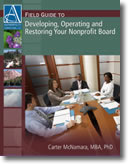
Field Guide to Developing, Operating, and Restoring Your Nonprofit Board. Most of the information in that book applies to nonprofit and for-profit Boards. Also, see Carter’s Board Blog.
Strategic Planning — Learn This Critical Skill for Board Members
The Consultants Development Institute’s Series Facilitating Strategic Planning provides free online courses, downloadable tools, and interaction with experienced faculty to learn the core skills to facilitate strategic planning for any kind of organization. This is a critical skill for prospective and current Board members. Enrollment is unlimited.
Learn More in the Library’s Blogs Related to This Topic
In addition to the articles on this current page, also see the following blogs that have posts related to this topic. Scan down the blog’s page to see various posts. Also, see the section “Recent Blog Posts” in the sidebar of the blog or click on “Next” near the bottom of a post in the blog. The blog also links to numerous free related resources.
For the Category of Boards of Directors:
To round out your knowledge of this Library topic, you may
want to review some related topics, available from the link below.
Each of the related topics includes free, online resources.
Also, scan the Recommended Books listed below. They have been
selected for their relevance and highly practical nature.